Thailand Backpacking: A Quick Guide - Click Here!
Search 120+ Hotel Websites at Once

travelhappy   Backpacking And Travelling In Thailand and South East Asia: A Personal Guide

Sukhothai, Thailand Tiger Temple Thailand Plain Of Jars, Laos

Explore more about: Bangkok | Thailand | Cheap Flights | Australia | Cambodia | China | Indonesia | Japan | Laos | Myanmar | Vietnam

Komodo Dragons: Up Close And Personal

Filed under: Indonesia    Written by:Chris Mitchell.

  Find The Cheapest Flights to Indonesia      Book Indonesia Hotels - Up To 70% Off!

The Komodo Dragons of Indonesia are the world’s biggest lizard, the nearest thing we have left to a dinosaur and can kill a man with a single bite. I travelled to meet them face to face in their home territory on the remote island of Komodo, deep within the Indonesian archipelago.
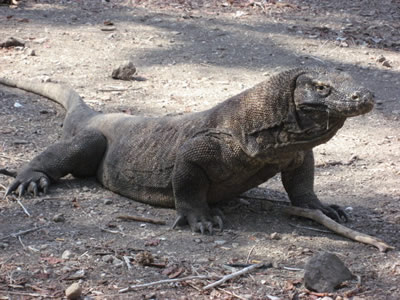
Coming face to face with the Komodo Dragons in their natural habitat is somewhat humbling. These huge lizards, up to 3 metres in length, have no fear of humans but humans certainly have reason to fear the Dragons - two tourists have died while visiting these apex predators on the remote Indonesian island of Komodo. The Dragons infamously have a bacteria-ridden mouth that causes death by infection from a single bite - the dragons bite their prey and then track the unfortunate victim for days if necessary while waiting for it to die. When they move, then you need to move right out of the way, as you can see from this very shaky video I shot while with the Komodo Dragons on Komodo Island.

Komodo Dragon, Indonesia

Dangerous, dung-mouthed and drooling - what, then, is the enduring appeal of the Komodo Dragon on our collective imaginations? First discovered by Europeans back in 1910, the Dragons are considered to be direct descendents of the dinosaurs, and certainly the nearest creature to the dinosaurs that we still have alive today. They are the world’s largest lizards and belong to the monitor lizard family.

The scorched mountains of Komodo certainly look like a real world Jurassic Park, abruptly rising from the sea beneath a relentless sun with little sign of human settlement. There is only one town (known as a kampung) on the island of Komodo, but the whole island and the seas around it are part of the Komodo National Park, put in place in the 1980s to protect the Dragon and the other creatures of this remote island habitat. The Dragons themselves were only discovered in 1911, and the remoteness of their natural habitat adds to the feel of having stepped back to somewhere truly primeval.


Komodo Dragon Up Close And Personal

We arrived at Komodo early one morning after three days sail from Bali on a scuba diving liveaboard around Komodo. Even in the 21st century, it is not easy to get to this remote island, which accounts for why it’s still not a major tourist destination. Infrastructure on the island for tourists is also very basic, and besides, you have to keep a lookout for the Dragons wherever you are on Komodo - there are around 6000 of them living on the island.

Even at 8 in the morning the heat was quite incredible - at least 35 degrees celsius and full humidity too. We took an hour long walk into the bush with our two watchful guides, both armed with big forked sticks to keep any marauding dragons at bay. The island’s landscape is desolately beautiful, the sun having reduced all the foliage to dry brown scrub. Apparently when the rainy season begins later in December the island transforms into lush green pasture within the space of two months. We spotted several cockatoos and a big spider whilst on our walk in the bush, as well as getting a fantastic panorama of the island and bay from a lookout point.

We didn’t spot a Komodo Dragon while on our walk, which was a obviously a shame. It would be necessary to spend several days on Komodo to properly explore the island. However, daytrippers like us don’t go away emptyhanded - there are several Dragons that actually live around the Conservation Headquarters - they’re particularly fond of camping out in the shade of the kitchen hut. You can smell them before you see them - given their foul mouths, personal hygiene is also not high on the Komodo Dragon agenda.


Komodo Dragon Feeding, Indonesia

At first seemingly sluggish stretched out in the shade, when the dragons are roused with the promise of a bit of food dangled from a pole above them, they are on their feet and in pursuit very quickly. The Dragons are not afraid to stand on one another to reach the food and demonstrate dominance - indeed, they are known cannibals, eating their own young on occasion.

They are also not afraid to check out the creatures standing around them taking photos - and when a Komodo Dragon starts heading towards you, they really do seem to move very fast indeed. They also make a distinct hissing sound when scenting food which is a warning to other Dragons to back off, although it has the same effect on humans too.

After half an hour or so with the Dragons, we left them in peace and headed back to our boat. It was something of a childhood ambition of mine to see the Komodo Dragons, and I still couldn’t quite believe it had happened as I stepped back onto our liveaboard. They are fascinating creatures and to see them in their natural habitat - albeit with some help from the kitchen slop bin - made it seem all the more possible that the Dragons are a throwback to prehistoric creatures. It also makes me wonder what else is living on Indonesia’s other 17,000 islands, many of which have never been fully explored and charted.

Posted on January 7th, 2007.

Save Money On Indonesia Flights And Hotels

Find The Cheapest Flights to Indonesia With Kayak.com
Book Indonesia Hotels Online - Up To 70% Off!

Other Travelhappy posts of interest:


Make A Comment: ( 8 so far )

blockquote and a tags work here.

8 Responses to “Komodo Dragons: Up Close And Personal”

RSS Feed for Travelhappy.info Comments RSS Feed

[…] I shoot quite a lot of video clips on my digital camera when I’m travelling. I love taking photos, but sometimes a quick 30 second video clip can capture a situation even better, and provides both great memories and a better way to show off some of the things you’ve seen on holiday. Given the way video has become so prevalent on the Web in the last 18 months, I wanted to start incorporating video clips into my webpages to go with my articles on the Komodo Dragons of Indonesia, the crazy busy streets of Hanoi, Vietnam and the amazing colours of cuttlefish underwater while scuba diving in Bali. The obvious answer was to use YouTube.com, the hugely popular video sharing service. Not only would it save me the bandwidth of putting the video files on my own website, the clips would also act as a way of inviting more people to come and visit Travelhappy. Uploading a video to YouTube is easy, so I won’t go through that here. The crucial bit, however, is getting the video ready to upload to YouTube in the first place. My Canon digital camera shoots video in AVI format and I’m guessing that’s the norm for most digital cameras. These produce good resolution video clips which are also big files - around 100 Megabytes for 30 seconds or so. YouTube doesn’t like the .AVI format and won’t accept clips over 100 megabytes. The answer is to compress the video to reduce its file size and change its format. This is easily done with the free open source program Dr DivX. Before you compress the clip, you might also want to edit it by chopping off any sections so that your clip gets straight to the point for your audience on YouTube. There is a great shareware program from Boilsoft called AVI/MPEG/RM/WMV Splitter that let’s you do limited cuts to video for free. It’s easy to understand and use too. Chopping out extraneous bits of your clip also helps reduce the file size. Once that’s done, it’s time to compress it. Dr DivX has a very simple interface. Choose the file you want to compress, select the settings you want and hit the encode button. I’ve found that High Theatre/Extreme Quality produce the best results for me, but you may want to pay around with the settings some more. Dr DivX crunches a 100 MB AVI clip to around 5 MB on average. YouTube likes the DivX format too, so once you’ve run your clip through Dr DivX, you’re ready to upload it to YouTube. Be aware that compressing a clip and then uploading it to YouTube is going to make the clip lose quite a bit of its picture quality. YouTube uses a Flash player to ensure it works in all web browsers which degrades the quality further. This usually isn’t a problem, but if you have something delicate or subtle - like the colour changes of the cuttlefish clip I mentioned earlier - it can degrade it quite severely. However, don’t get too precious about it. I uploaded the Bali Cuttlefish clip with some misgivings about its quality, and it’s still been viewed 400 times in the space of the last month and got a couple of ego swelling comments. People will put up with so-so quality if there’s something interesting to see. However, if you think it warrants it, you can upload the original DivX clip to Stage6.com, DivX’s own answer to YouTube. This houses clips in all their uncompressed glory, and you can embed them in your own webpages YouTube-style as well, by visiting this DivX webpage embedder generator. The only problem with embedding DivX video files in your webpages is that a) they take a long time to load as they are much bigger files than typically found on YouTube and b) unlike YouTube, DivX requires certain files installed on the viewer’s computer to see them. Therefore, it seems wise to offer the user a choice - upload the clip in YouTube and put a link to the higher res, longer download DivX version on Stage6.com too, if you think it warrants the extra effort for you and the user. In conclusion, it’s a pretty easy process to prepare your digital camera video clips for YouTube when you’ve got the right bits of software to do it. It took me a while to figure out all the right steps to editing and compressing my videos though, so I hope this is useful. If you have better suggestions of how to make digital camera video clips ready for YouTube, do let me know in the comments. Related articles you might find useful:“Bus Uncle” Hong Kong Video Huge Internet HitSony Ericsson 750i review: the perfect travel phone?Komodo Dragons: Up Close And PersonalBuying Cameras In TokyoHotelReservations.com Review […]

[…] I wrote a full report about the Liberty shipwreck and scuba diving in Bali on my dive blog Divehappy. As I was passing through Bali on my way to a diving liveaboard to Komodo (where we saw the Komodo Dragons), I sadly didn’t get a chance to properly explore the island above the water - I would love to see some of the spectacular Bali temples, like the Mother Temple , and also the cultural village of Ubud. […]

its really cool being able to see ome thing thats realating to dinosaurs so this is hellza cool

alyssa
April 13th, 2007

its very iteresting to see a resembelence of dinosaurs so camodos are hellza cools and really interesting so whom ever is reading this pasa mea rasa

alyssa
April 13th, 2007

[…] previously wrote about getting a very up close and personal encounter with the Komodo Dragons here, complete with some very shaky video footage, and also a quick rundown of what I did in Bali, […]

tis was a great story i wonder if it is to danger to go to indonesia?

diego
December 2nd, 2007

[…] - including my somewhat shaky video close encounter with them - have a look at my previous article Komodo Dragons: Up Close And Personal. There’s also my page on coming face to face with a deadly sea snake - which was nice - and […]

That is amazing!!!!!

sarah
February 8th, 2008

Where's The Comment Form?

Search

Find Indonesia Flights And Hotels

Cheap Flights To Indonesia - Kayak.com
Book Indonesia Hotels - Up To 70% Off!

Don't Miss This!

About Travelhappy.info

Travelhappy is edited by me, Chris M. I'm a British travel writer based in Bangkok, Thailand.[more info]

Thailand Diving

Koh Lanta Diving


Get Travelhappy
emailed to you


Enter your email address:

Delivered by FeedBurner

RSS